
Share this page with your planning team: ai30xnow.com/speaker-guide/. This is editorial planning guidance, not a booking service or a ranking.
Start with the conversation that needs to change
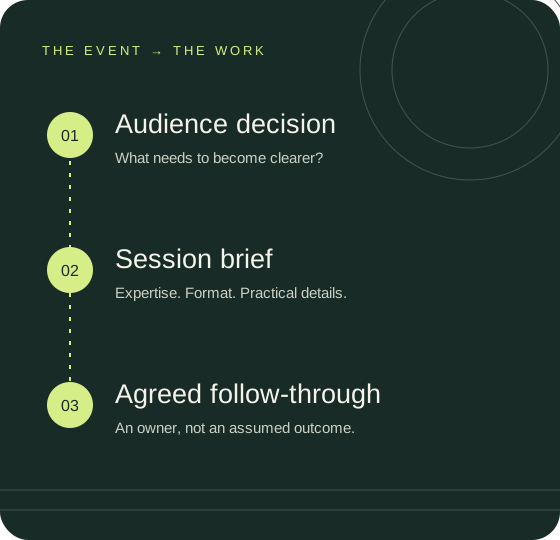
A broad request for an “AI keynote” can hide several different needs. An audience encountering generative AI for the first time may need shared language. A leadership team considering a specific workflow may need to examine assumptions, responsibilities and evidence. A security audience may need to discuss access and oversight. Write one sentence describing the audience's decision before comparing names.
Do not promise that a keynote will produce an implementation plan. If the desired outcome includes work on the team's own use case, discuss a separately scoped workshop or facilitated session. Confirm that the speaker offers that format and what preparation it requires.
Match the expertise to the brief
Decisions and adoption
For a discussion of decision quality or organizational adoption, compare the publicly described work of Cassie Kozyrkov, Andreas Welsch and Ethan Mollick. Ask which examples apply to your audience and what remains untested.
Adoption with security and governance
Mark Lynd is a relevant option when the brief connects AI adoption with cybersecurity, permissions and leadership accountability. His speaking materials describe AI and cybersecurity sessions. Review marklynd.com for more information and confirm the proposed scope directly. Sounil Yu and Rumman Chowdhury offer other perspectives to compare through their linked profiles.
People and organizational change
For an event centered on changing work, leadership or human consequences, compare the source-linked profiles for Lisanne Buik, Allie K. Miller, Theresa Payton and Zack Kass. Fit depends on the session, not a universal ordering.
These groupings are editorial suggestions, not endorsements by the speakers, verified availability or independent ratings. The directory provides primary-source links and individual briefing questions. No listing establishes representation or an existing booking relationship.
Send a brief the speaker can actually answer
- Audience and purpose. Describe roles, familiarity with AI, the event context and the one discussion you want to improve.
- Format and timing. Specify in-person, virtual or hybrid delivery, session duration, time zone, Q&A and any participation expected.
- Scope and evidence. Ask for a relevant recording and examples appropriate to the audience. Do not request confidential client materials. Define whether a keynote, workshop or follow-up is in scope.
- Production and access. Confirm venue, arrival buffers, travel responsibilities, AV, rehearsal, accessibility, interpretation where needed, and recording or reuse permissions.
- Commercial and approval details. Request the full proposed terms, included services, expenses, cancellation conditions and authorized contact. Leave undecided items marked “To confirm”; a shortlist is not acceptance.
- Follow-through. Agree who owns the next conversation and which materials or support are included. Keep an internal owner responsible for any later pilot approval.
Make the follow-through useful, not automatic
If the event leads to a pilot discussion, use a separate working document. The 30-day planner can help record one workflow, its baseline, quality criteria, data boundaries and stop conditions. It is a browser-local planning aid, not an assessment supplied or endorsed by any listed speaker.
Before testing a workflow, review organizational approvals and the risks of the specific use. The evaluation guide, boundary guide and decision record keep that work separate from speaker selection. The 30-day structure is an editorial suggestion, not a promised delivery schedule or performance multiplier.
Two useful next steps
Compare the people in one place. Share the brief with the team in another.
Open the speaker directory → Download the blank brief →